

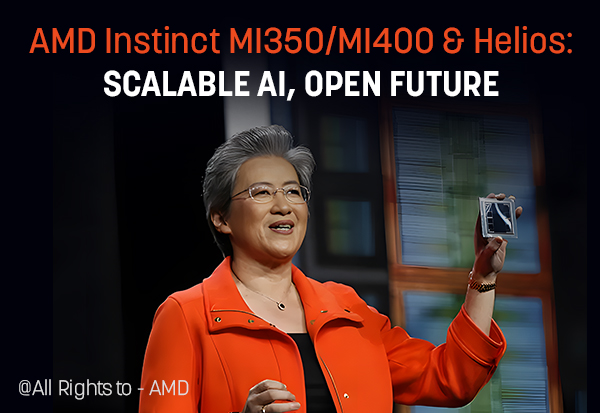
AMD’s Game-Changer: Instinct MI350/MI400 & Helios—Delivering Open, Scalable AI Infrastructure
In our ongoing series on AI accelerators, we previously explored the hardware fueling the AI revolution. Now, we turn our focus to AMD’s latest unveilings—the Instinct MI350/MI400 GPUs and Helios rack-scale system. These innovations tackle critical bottlenecks in AI infrastructure, positioning AMD as a key player in the Gen AI space. Let’s break down the problems, AMD’s solutions, and what this means for engineers.
The Bottlenecks in AI Infrastructure
AI’s rapid evolution has exposed three major hurdles:
- Compute Saturation: As models scale to billions of parameters, legacy GPUs struggle to keep up, causing delays in training and inference.
- Memory & Bandwidth Woes: Large models demand fast access to vast datasets. Current memory capacities and interconnects often fall short.
- Ecosystem Lock-In: Proprietary ecosystems, like NVIDIA’s CUDA and NVLink, limit flexibility and inflate costs.
AMD’s Answer: Instinct MI350/MI400 & Helios
Technical Comparison: AMD vs. NVIDIA
How does AMD stack up against NVIDIA? Here’s a breakdown:
| Feature | AMD MI400 / Helios | NVIDIA Vera Rubin NVL144 |
|---|---|---|
| HBM / Bandwidth | 432 GB / 19.6 TB/s HBM4 | ~288 GB / ~13 TB/s HBM4+ |
| Compute (Rack) | 2.9 ExaFLOPS FP4 | ~3.6 ExaFLOPS FP4 |
| Interconnect | UALink/Ethernet (300 GB/s) | NVLink (~1.8 TB/s, proprietary) |
| Ecosystem | ROCm 7 (open-source) | CUDA/NVLink (closed) |
- Memory Advantage: AMD’s superior capacity and bandwidth excel in memory-intensive Gen AI tasks.
- Compute Trade-Off: NVIDIA edges out in raw compute, but AMD’s memory focus often matters more.
- Openness: AMD’s UALink and ROCm 7 foster flexibility, while NVIDIA’s proprietary stack locks users in.
AMD’s approach prioritizes scalability and cost-efficiency, challenging NVIDIA’s dominance.
Industry Response
AMD’s announcements have sparked excitement. At Advancing AI 2025, partners like Meta, OpenAI, and Oracle Cloud Infrastructure (OCI) praised the innovations. Meta leverages Instinct MI300X for Llama models and anticipates MI350’s cost-performance benefits. OpenAI’s Sam Altman highlighted AMD’s optimized hardware-software synergy. OCI is adopting MI355X for zettascale clusters, signaling strong adoption potential.
What’s in It for Engineers?
- AI Engineers: Enhanced compute and memory unlock faster training and inference for complex Gen AI models, speeding up innovation.
- Embedded Systems Engineers: Scalable, efficient designs simplify integrating AI into constrained devices like IoT gadgets or autonomous systems, aided by open tools.
AMD’s open ecosystem reduces vendor dependency, empowering engineers with flexibility and lower costs.
Conclusion
AMD’s Instinct MI350/MI400 GPUs and Helios system mark a turning point in AI infrastructure. By solving compute, memory, and ecosystem challenges with powerful, open solutions, AMD is redefining the Gen AI landscape. For engineers, this means more robust tools to push AI’s boundaries-whether in data centers or edge devices.

