

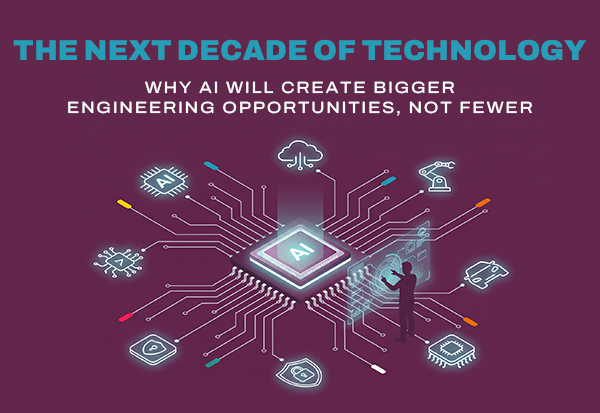
The Next Decade of Technology: Why AI Will Create Bigger Engineering Opportunities, Not Fewer
AI Is Changing the Rules of Technology
For nearly two decades, the global technology industry followed a familiar formula:
build larger engineering teams, scale software delivery, expand outsourcing, and continuously hire more developers, testers, support engineers, and program managers.
As digital transformation accelerated worldwide, technology employment expanded alongside it.
Today, that model is evolving faster than ever before.
Artificial Intelligence is creating the biggest productivity shift the software industry has ever experienced. Tasks that once required entire teams can now increasingly be handled by smaller groups of highly capable engineers working alongside AI-powered tools.
Code generation, debugging, testing, documentation, infrastructure management, workflow automation, and even parts of project coordination are becoming dramatically more efficient.
But this does not mean technology jobs are disappearing.
It means the nature of technology work is changing.
AI Is Not Replacing Engineering – It Is Redefining It
 The world is becoming more software-driven every day.
Industries across the globe – including healthcare, automotive, manufacturing, telecom, defense, banking, and consumer electronics – continue moving toward intelligent and connected systems.
That demand is not slowing down.
What is changing is the type of engineering talent companies need.
Routine, repetitive, process-heavy work is becoming increasingly automated. Organizations no longer need large teams for tasks that AI systems can complete faster and more efficiently.
This shift is especially significant for traditional outsourcing models that relied heavily on workforce expansion.
In the AI era, productivity per engineer is increasing rapidly. As a result, companies are beginning to optimize for:
- smaller teams,
- deeper technical expertise,
- faster execution,
- and higher engineering impact.
The future will reward engineering capability – not just engineering scale.
The Biggest Opportunity Is Moving Deeper Into Engineering
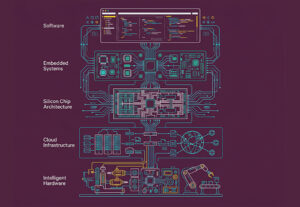 While some layers of software execution become automated, another massive transformation is happening at the same time:
The world is entering a historic buildout of AI infrastructure.
AI systems cannot exist without enormous investments in:
- semiconductors,
- compute infrastructure,
- embedded systems,
- networking,
- cloud platforms,
- edge devices,
- cybersecurity,
- and intelligent hardware.
Every AI breakthrough increases the importance of deep engineering.
This is why some of the strongest growth areas of the next decade are expected to include:
- Semiconductor Engineering
- AI Accelerators & Compute Infrastructure
- Embedded Systems
- Robotics & Automation
- Cybersecurity
- Automotive Electronics
- Cloud & Distributed Computing
- Aerospace & Defense Technology
- Industrial Automation
- Connected Healthcare Systems
These are not low-complexity domains.
They require:
- systems thinking,
- performance optimization,
- hardware-software integration,
- multidisciplinary collaboration,
- real-world problem solving,
- and continuous innovation.
Unlike repetitive digital workflows, these areas are significantly harder to automate fully.
Why Semiconductors Will Become Even More Important?
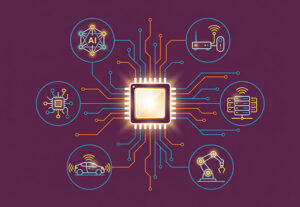 Among all technology sectors, semiconductors may emerge as one of the biggest long-term beneficiaries of the AI revolution.
Every AI model, autonomous system, cloud platform, intelligent device, industrial robot, or connected infrastructure layer ultimately depends on silicon.
As global AI adoption accelerates, demand for:
- high-performance compute,
- energy-efficient architectures,
- AI accelerators,
- advanced packaging,
- edge AI systems,
- and specialized semiconductor platforms
will continue growing at unprecedented scale.
This creates expanding opportunities across:
- RTL Design
- Design Verification
- Physical Design
- Embedded Software
- Firmware Development
- System-on-Chip (SoC) Integration
- AI Hardware Acceleration
- Performance & Power Optimization
- Edge AI Engineering
- Advanced Semiconductor Tooling
The future of intelligence will be built on semiconductor innovation.
The Engineer of the Future Will Be Different
 The next decade will reward engineers who combine:
- technical depth,
- adaptability,
- AI-enabled workflows,
- systems understanding,
- and business awareness.
The future engineer is not someone who only writes isolated code modules.
The future belongs to professionals who can:
- understand complete systems,
- solve ambiguous problems,
- leverage AI as a productivity multiplier,
- and continuously evolve with technology.
This shift is already changing:
- hiring patterns,
- salary structures,
- organizational models,
- and engineering expectations across the industry.
Companies are becoming leaner.
Startups are operating with smaller teams.
Productivity expectations per engineer are rising rapidly.
But for engineers willing to adapt, the opportunity ahead may be larger than ever before.
The Companies That Will Lead the AI Era
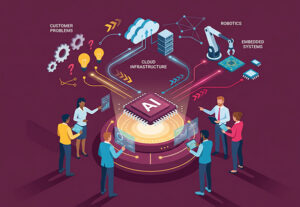 The organizations that succeed in the next technology cycle are unlikely to be those focused only on workforce scale.
The winners will be companies that:
- build deep engineering capability,
- adopt AI-assisted execution,
- invest in continuous learning,
- strengthen multidisciplinary expertise,
- and stay closer to strategic customer problems.
At BITSILICA, we believe the future belongs to engineering teams that combine strong technical foundations with the ability to adapt quickly in an AI-driven world.
The next decade is not about resisting AI.
It is about learning how to build faster, smarter, and deeper with it.
The Next Decade Will Reward Adaptability
 Historically, every major technological revolution has eventually created more opportunity than disruption.
The Industrial Revolution, the rise of computing, the internet era, and mobile technology all transformed labor markets while also generating entirely new industries.
The difference with AI is speed.
This transition is happening faster than previous technology shifts, creating uncertainty for professionals tied to repetitive digital workflows.
But periods of disruption are also periods where entirely new leaders emerge.
The next decade will reward:
- agility,
- innovation,
- engineering leverage,
- deep technical expertise,
- and continuous learning.
For the semiconductor and deep-tech ecosystem, the biggest opportunities may still be ahead.
The AI era is only beginning.
And the infrastructure powering it still needs to be:
- designed,
- verified,
- optimized,
- secured,
- manufactured,
- and integrated into every industry worldwide.
That future will require ambitious companies, capable engineers, and organizations willing to continuously reinvent themselves.
This is not the time to slow down.
This is the time to prepare for the next great technology cycle.

