

Deploying LLMs on Embedded Devices: Reality or Hype?
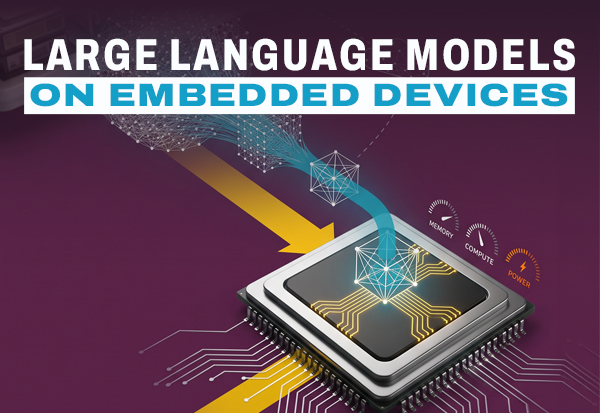
Large Language Models (LLMs) have quickly moved from cloud-based chatbots to software that is beginning to run directly on our phones, laptops, vehicles, robots, and industrial equipment. Every major technology company is investing in on-device AI, promising better privacy, faster responses, and intelligence that works even without an internet connection.
At first glance, the idea sounds straightforward: instead of sending every prompt to a cloud server, simply run the model on the device itself.
In practice, however, this is one of the most demanding engineering problems in AI today.
The conversation often swings between two extremes. Some believe every embedded device will soon run sophisticated LLMs independently. Others argue that meaningful AI will always require cloud-scale GPUs. As is often the case, the truth lies somewhere in between.
Running AI Where the Data Is
 Traditional LLM applications rely on cloud infrastructure. Every user request travels over the network to powerful GPU clusters, which perform inference and return the response.
On-device inference flips this model. The computation happens locally on the phone, automotive ECU, industrial controller, Raspberry Pi, wearable, or edge gateway.
This architectural shift offers several compelling advantages.
Privacy is perhaps the biggest. Sensitive information—health data, voice conversations, industrial process information, financial records, or personal documents—can remain entirely on the device without leaving the user’s control.
Latency improves as well. Eliminating network round trips makes responses almost instantaneous, an important advantage for voice assistants, robotics, driver assistance systems, and industrial automation where milliseconds matter.
Local inference also enables reliable operation in environments where connectivity is unreliable or unavailable. Manufacturing plants, remote mining sites, offshore installations, field equipment, and rural deployments cannot always depend on continuous internet access.
For companies deploying millions of devices, reducing cloud inference also lowers recurring infrastructure costs. Rather than paying for every API request throughout a product’s lifetime, much of the computation is performed once on hardware that already exists.
These advantages explain why companies such as Apple, Google, Qualcomm, Microsoft, NVIDIA, and others are investing heavily in edge AI capabilities.
The Engineering Reality
 Despite the attractive benefits, embedded devices operate under constraints that are fundamentally different from cloud servers.
Memory is the first and often the biggest obstacle.
A modern LLM consists of billions of parameters that must be stored in memory, along with the operating system, inference runtime, application software, and the model’s growing key-value (KV) cache used during text generation. Even devices with several gigabytes of RAM can quickly reach their limits.
Power presents another challenge.
Data-center GPUs comfortably consume several hundred watts of power with sophisticated cooling systems. Embedded systems frequently operate within power budgets of only a few watts, and many rely entirely on batteries without active cooling. Every additional watt directly impacts thermal design, battery life, and product reliability.
Compute capability is equally constrained.
Even advanced edge SoCs deliver only a fraction of the computational throughput available in modern AI servers. Running the same model with identical precision simply isn’t feasible.
Hardware diversity further complicates deployment.
Unlike cloud infrastructure, where GPU architectures are relatively standardized, embedded AI spans ARM CPUs, mobile NPUs, integrated GPUs, DSPs, FPGAs, automotive AI accelerators, and increasingly specialized inference chips. Optimizations that work well on one platform often require significant re-engineering for another.
In embedded AI, portability is rarely automatic.
The Innovations Making Local AI Possible
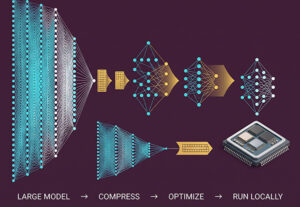 The impressive progress in on-device LLMs has not come from faster processors alone. It has been driven by advances across model compression, numerical optimization, and inference software.
Quantization has become the cornerstone of embedded deployment.
Instead of storing every parameter in 16-bit floating point format, weights are compressed to 8-bit, 4-bit, or even lower precision. Modern formats such as GGUF, widely used with llama.cpp, support multiple quantization schemes that dramatically reduce memory requirements while maintaining acceptable accuracy for many applications.
The gains can be substantial. Models that previously required well over 10 GB of memory can often operate within 1–2 GB after 4-bit quantization, while inference speed on CPUs improves several times over because significantly less data needs to be moved through memory.
Memory optimization extends beyond model weights.
The KV cache grows continuously as text is generated and can eventually consume more memory than the model itself during long conversations. Current research focuses on adaptive KV-cache compression, variable precision allocation, and smarter cache management techniques that reduce memory growth without significantly affecting model quality.
Other compression techniques also contribute.
Model pruning removes parameters that contribute little to output quality. Knowledge distillation transfers capabilities from larger models into smaller ones. Low-rank approximation reduces computational complexity while preserving much of the original performance.
Another important shift has been the rise of Small Language Models (SLMs).
Rather than compressing extremely large models, researchers increasingly design compact models from the ground up for specific domains. Models in the 1–8 billion parameter range often provide an excellent balance between capability, efficiency, and deployment practicality for embedded applications.
Equally important are the software runtimes that make these optimizations usable.
Projects such as llama.cpp, MLC-LLM, Candle, PowerInfer, Tengine LLM, and TinyChat have dramatically improved CPU and edge-device inference through optimized kernels, hardware-aware scheduling, and efficient memory management. Their contributions are as significant as advances in the models themselves.
What Hardware Can Actually Run LLMs?
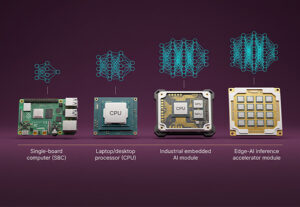 The answer depends entirely on what “running an LLM” means.
Single-board computers such as Raspberry Pi 5 have demonstrated that 4-bit quantized models in the 3B–7B parameter range can run locally. While they are not designed for high-throughput inference, they provide excellent development platforms for experimentation, education, and lightweight edge AI applications.
Embedded AI platforms, particularly NVIDIA Jetson systems and similar industrial AI modules, offer significantly higher performance through integrated GPUs and NPUs. These platforms are increasingly common in robotics, autonomous machines, industrial inspection, smart cameras, and intelligent edge gateways.
Dedicated inference accelerators target a different market altogether. These chips focus on executing highly optimized, quantized AI models with extremely low power consumption. They are well suited for embedded pipelines where latency and energy efficiency matter more than supporting the largest possible language model.
Modern desktop and laptop CPUs also remain surprisingly capable. Using optimized runtimes and 4-bit quantization, CPUs can provide practical performance for many 1B–7B parameter models without requiring dedicated AI hardware. This has made local LLM experimentation accessible to a much wider developer community.
Where the Hype Begins?
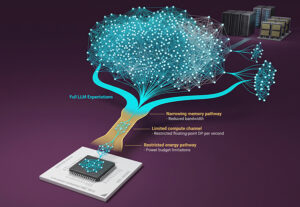 The excitement surrounding embedded LLMs is justified, but some claims deserve careful scrutiny.
Large reasoning models with tens of billions of parameters remain overwhelmingly dependent on cloud infrastructure. Even after aggressive quantization, these models require substantial memory bandwidth and computational resources that most embedded devices simply cannot provide. Running such models on older CPUs often results in generation speeds of only a few tokens per second, making interactive use impractical.
Quantization itself is not free.
Reducing precision too aggressively can introduce noticeable accuracy degradation, unstable outputs, and weaker reasoning performance. This explains why adaptive quantization and hardware-aware optimization remain active research areas rather than solved engineering problems.
Platform fragmentation is another challenge often overlooked in marketing material.
Optimizing a model for one NPU or AI accelerator rarely guarantees good performance elsewhere. Differences in supported operators, kernel implementations, memory layouts, compiler toolchains, and quantization formats frequently require substantial additional engineering effort before deployment.
Finally, the phrase “real-time embedded AI” can mean very different things.
A Jetson AGX Orin operating within a 60-watt power envelope is fundamentally different from a battery-powered wearable or a microcontroller consuming only a few hundred milliwatts. Treating all embedded platforms as equivalent oversimplifies the engineering reality.
Reality, Not Hype
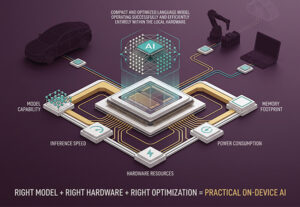 The most useful way to think about embedded LLM deployment is as a balancing act.
Every deployment involves trade-offs between model accuracy, inference latency, memory footprint, power consumption, and hardware cost. Improving one dimension almost always affects another.
For smartphones, AI PCs, industrial edge systems, robotics platforms, automotive computing, and modern ARM-based processors, on-device LLMs have already become a commercial reality. Millions of users interact with local AI every day through features shipped by companies including Apple, Google, Microsoft, and Qualcomm.
For tiny microcontroller-class devices, however, the story is different. Running sophisticated, general-purpose reasoning models remains well beyond today’s practical limits. Physics still matters. Memory capacity, compute throughput, and power consumption remain hard constraints that software alone cannot eliminate.
Perhaps the biggest misconception is that LLMs have simply “become smaller.”
What has truly enabled on-device AI is the emergence of an entire ecosystem of innovations: quantization techniques, KV-cache optimization, efficient transformer architectures, compact language models, compiler technology, and highly optimized inference runtimes working together.
That ecosystem continues to evolve rapidly, and each improvement expands the range of devices capable of running useful AI locally.
The future of embedded AI is therefore neither hype nor magic. It is the result of years of careful systems engineering, where advances in algorithms, software, and hardware converge to make intelligence practical beyond the cloud.

