

Agentic Workflows: Orchestrating AI Agents for Complex Tasks
Heard that building agentic AI pipelines is insanely complex?
Believe it or not, coordinating a team of AIs isn’t new — it’s just how we’ve always tackled big projects. Would you hire one unicorn developer to design your UI, write the backend, model your database, and set up CI/CD all alone? Of course not. You assemble a team with specialized roles.
Why wouldn’t we apply the same principle to AI?
Traditional AI workflows often suffer from:
- Context overload & hallucinations when one model tries to do everything
- Manual “glue code” leading to fragile hand-offs
- Hidden errors that only surface at the end
- Rigid pipelines that break when one component changes
Agentic workflows solve these by splitting work across specialized AI agents — each with clear roles, interfaces, and validation loops.
1. Anatomy of an Agentic Workflow
A robust agentic workflow breaks tasks into five key stages:
- Ingest – Data-fetching agents handle spreadsheets, APIs, documents, etc.
- Plan – A planner agent decomposes the goal into subtasks.
- Execute – Specialist agents perform each step.
- Review – Critic agents validate outputs.
- Adapt – Reflection agents adjust or escalate when needed.
2. Why Agentic Workflows Matter Now?
- LLM Evolution: Modern models excel at reasoning and tool use but need proper orchestration.
- Maturing Toolsets: Frameworks like LangChain, AutoGen, and Reflexion make orchestration easier.
- Real-World Demand: Businesses want reliable, end-to-end automation without brittle scripts.
3. Leading Frameworks for Agentic AI
| Framework | Core Strengths |
|---|---|
| LangChain | Modular agent types (planner, executor, critic) with rich tool integrations. |
| AutoGen (MSR) | Built-in multi-agent chat abstractions; highly customizable behaviors. |
| Reflexion | Verbal reinforcement learning — agents learn by reflecting on feedback. |
| ReAct | Merges chain-of-thought reasoning with external tool actions. |
Each framework offers building blocks for prompt templates, agent orchestration, and validation loops, so you can focus on your domain logic.
4. Real-World Example: End-to-End Web App Development
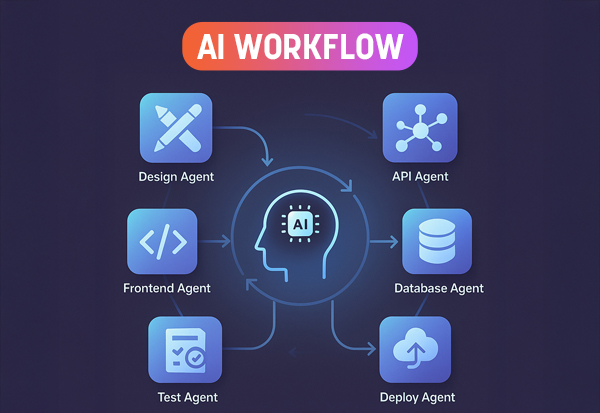
The super-developer fallacy: Expecting one “AI brain” to handle UI, API, database schemas, testing, and deployment is like asking one engineer to own every layer of app development. In practice, we build cross-functional teams:
- UI/UX designer → mockups and wireframes
- Front-end engineer → React/Vue components
- Back-end engineer → REST/GraphQL APIs
- DBA → schema design and migrations
- DevOps/QA → CI/CD pipelines and testing
Agentic workflows apply the same principle:
Each “AI agent” is a specialist with clear inputs, outputs, and checks:
- Design Agent (UI expert)
- Translates a product brief into wireframe JSON or component stubs.
- Front-end Agent (React specialist)
- Converts stubs into production-ready React code and styling (Tailwind, Material UI).
- API Planner Agent (schema guru)
- Drafts the API contract (endpoints, data models) based on UI data needs.
- Back-end Agent (server wizard)
- Implements endpoints, validation, and core business logic in your chosen stack (Express, FastAPI).
- Database Agent (DBA)
- Generates SQL migrations, optimizes indexes, and enforces integrity constraints.
- Integration Agent (DevOps)
- Assembles Docker Compose or Kubernetes manifests, sets up authentication and notifications.
- Test Agent (QA analyst)
- Writes unit, integration, and end-to-end tests (Jest, Cypress, Playwright).
- Deploy Agent (release engineer)
- Configures CI/CD (GitHub Actions, GitLab CI), deploys to cloud (AWS, GCP, Azure), and sets up monitoring.
- Review & Reflection Agents (team lead + scrum master)
- Run smoke tests and performance checks; loop back on failures or trigger human review.
Benefits of This Approach
- End-to-End Automation: No more brittle glue code—agents hand off work cleanly.
- Rapid Iteration: Change one layer (e.g., data model) and only the affected agents re-execute.
- Built-In Validation: Tests and sanity checks at every hand-off catch errors early.
- Scalable Maintenance: Swap in improved agents (e.g., a better front-end generator) without rewriting the whole pipeline.
5. Best Practices for Building Agentic Workflows
- Define Clear Interfaces: Use JSON schemas or typed prompts for agent hand-offs.
- Limit Context: Give each agent only the information it needs to reduce hallucinations.
- Embed Validators: Include simple sanity checks (numeric bounds, schema validation) between stages.
- Monitor & Log: Track success rates and latencies per agent to pinpoint bottlenecks.
- Enable Human-in-Loop: Provide checkpoints for manual overrides on critical decisions.
6. The Road Ahead
Agentic workflows are evolving rapidly. Watch for:
- Real-time Multimodal Agents that combine vision, audio, and language.
- Continuous Learning Loops where agents refine strategies over weeks or months.
- Agent Marketplaces sharing battle-tested sub-agents for common tasks.
By orchestrating specialized agents, organizations transform brittle scripts into resilient, scalable pipelines—freeing teams to focus on strategic, creative work.
References
- Google DeepMind Gemini 2.5 “Thinking Models”
- LangChain Documentation
- AutoGen (Microsoft Research)
- Reflexion: Language Agents with Verbal Reinforcement Learning (Shinn et al., NeurIPS 2023)
- ReAct: Synergizing Reasoning and Acting in Language Models (Yao et al., ICLR 2023)

