



AI Is Not One Stack, But Two Interlocking Realities
Artificial intelligence is often spoken about as a single technological wave, but in practice it unfolds across two very different layers of innovation. One is rooted in physics, manufacturing constraints, and capital intensity. The other lives in systems integration, organizational behavior, and operational discipline. Both are advancing rapidly, yet they obey entirely different rules. Understanding where value is created—and where it is capped—requires separating these layers without treating them as competitors.
The Physics Layer: Where Possibility Is Defined
 At the foundation of modern AI lies compute engineered for extreme workloads. Training and inference stress different parts of the system, but both expose the same fundamental limits: memory bandwidth, power density, interconnect latency, and thermal dissipation. Progress here is driven less by abstract algorithms and more by tight co-design between silicon architectures, advanced packaging, high-bandwidth memory, and software runtimes that can exploit them efficiently.
This layer moves slowly but decisively. Development cycles stretch across years, capital commitments are irreversible, and mistakes are brutally expensive. When a compute platform succeeds, it tends to pull an ecosystem around it—toolchains, compilers, optimized kernels—creating deep lock-in. Value compounds because scarcity compounds. Once built, marginal usage is cheap, but entry remains prohibitively hard.
The Systems Layer: Where AI Becomes Real
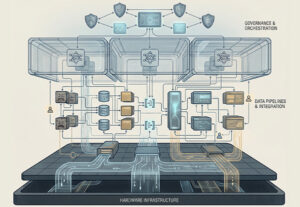 Above the physics sits a quieter, messier problem space: turning raw AI capability into something enterprises can actually run. Here the obstacles are not FLOPS or memory channels, but fragmented data, undocumented processes, and risk boundaries that models cannot wish away. AI systems must coexist with decades of legacy software, regulatory scrutiny, and human accountability.
This layer is dominated by orchestration rather than invention. Models are wrapped with retrieval pipelines, policy engines, monitoring loops, and human-in-the-loop controls. Drift is not an edge case but an expectation. Explainability is not optional; it is a prerequisite for deployment. The real intellectual work lies in designing failure modes that degrade safely and feedback loops that improve decisions without eroding trust.
Different Economics, Different Moats
 The economic logic of these layers diverges sharply. Compute-led innovation is capital-intensive and winner-skewed. Once leadership is established, margins expand and scale reinforces itself. Systems-led AI, by contrast, is execution-heavy. It scales through repeatable architectures, platforms, and process maturity, but remains bounded by talent and delivery capacity unless deliberately abstracted.
This is why applied AI revenues, even when large, behave differently from platform revenues. They grow by expanding the surface area of adoption, not by redefining the cost curve of computation itself. Their defensibility comes from trust, domain understanding, and integration depth rather than technological exclusivity.
The Direction of Dependency
 Although these layers are often discussed side by side, the dependency runs mostly in one direction. As compute becomes cheaper, more efficient, and more available, new AI use cases cross the threshold from experimental to economical. When compute is constrained, adoption retreats to only the highest-ROI workflows. The systems layer expands or contracts based on decisions made far below it, in fabs and architecture roadmaps.
This asymmetry matters. It explains why periods of rapid applied AI adoption often follow breakthroughs in hardware efficiency, and why hype cycles stall when infrastructure fails to keep pace with expectations.
Where the Stack Is Headed?
 The future of AI will not be decided by models alone, nor by services alone, but by how cleanly these layers interlock. Durable systems will be hardware-aware without being hardware-dependent, able to absorb shifts in compute architecture without constant reinvention. At the same time, advances in compute will increasingly be shaped by real workload behavior rather than synthetic benchmarks, because demand is defined upstream by operational reality.
Seen through this lens, today’s AI moment looks less like a race and more like the early construction of an industrial stack. Physics defines the ceiling, systems design determines throughput, and organizations decide what actually reaches production. The excitement sits at the top, but the gravity comes from the bottom—and the hardest work happens in between.

