

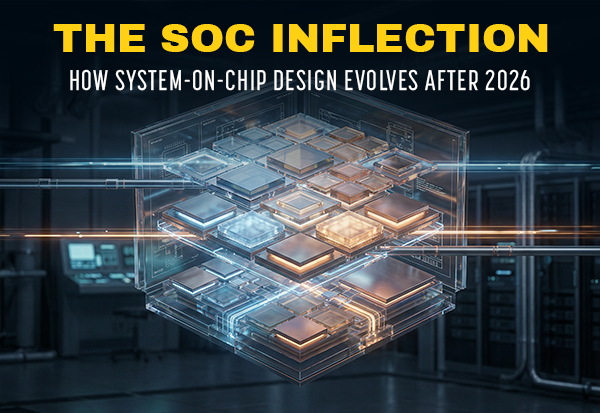
The SoC Inflection: How System-on-Chip Design Evolves After 2026
By 2026, system-on-chip design reaches a structural inflection point. The challenge is no longer how many functions can be pulled onto a single die, but how coherently complexity can be distributed without collapsing under verification cost, power density, and design latency. The classical SoC playbook—larger monoliths at newer nodes—continues to exist, but it stops being the dominant path for differentiation. What replaces it is not a single technology shift, but a layered redefinition of what “system” means in silicon.
Monolithic Scaling Gives Way to Architectural Selectivity
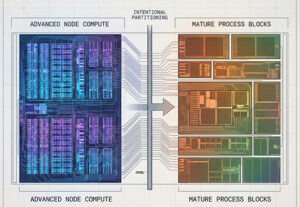 Advanced nodes remain indispensable for high-frequency logic and dense compute arrays, yet SoCs stop being uniformly scaled entities. By the mid-2020s, designers become highly selective about which blocks justify leading-edge transistors. Control logic, analog interfaces, and large SRAM macros increasingly migrate to mature nodes, while performance-critical tiles absorb the cost of advanced process technology.
This asymmetry reshapes SoC floorplanning. Instead of one massive die dominated by routing congestion and power integrity constraints, the system is partitioned along power, frequency, and reliability domains. The “chip” becomes an assembly of intent-driven components rather than a uniform silicon canvas.
Chipletization Becomes the SoC, Not an Add-On
 Chiplets are no longer a packaging trick; they become the organizing principle of SoC design. By 2026 and beyond, internal SoC boundaries increasingly resemble inter-chip boundaries, with well-defined protocols, latency contracts, and coherency scopes. High-speed die-to-die links evolve to support cache-coherent fabrics, memory semantics, and quality-of-service guarantees.
This forces a shift in design methodology. Architects begin designing for failure isolation, graceful degradation, and upgradeability. A defective or underperforming tile no longer invalidates an entire system. Instead, redundancy and binning strategies are pushed up into the architectural layer, blurring the line between silicon design and system software.
Power Delivery and Thermal Architecture Take Center Stage
 As compute density continues to rise, power delivery becomes a first-order architectural constraint. Traditional top-side power routing struggles to sustain current density without excessive IR drop and noise. The response is a rethinking of power architecture: backside power delivery, localized regulation, and fine-grained voltage domains integrated directly into SoC partitions.
Thermal design follows a similar trajectory. Rather than treating heat as a post-layout problem, SoCs are architected with thermal zoning in mind. High-activity tiles are spatially and temporally isolated, workloads are scheduled with thermal awareness, and packaging materials are co-optimized with silicon to maintain predictable operating envelopes.
Memory Integration Shifts from Capacity to Proximity
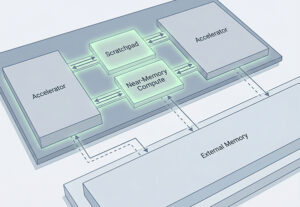 SoC memory strategy evolves from simply increasing on-chip capacity to optimizing data proximity and movement. Large shared caches give way to hierarchies tuned for specific traffic patterns. Scratchpads, near-memory compute, and tightly coupled accelerators reduce round-trip latency and energy per access.
External memory interfaces remain critical, but their role changes. Instead of acting as a universal backing store, off-chip memory becomes a managed resource, accessed through prefetching, compression, and locality-aware scheduling. The SoC’s intelligence increasingly lies in how little data it moves, not how fast it can move everything.
Verification, Not Transistors, Becomes the Bottleneck
 By 2026, verification effort dominates SoC schedules. The explosion of configuration space—multiple chiplets, power states, coherency modes, and workload-dependent behaviors—makes exhaustive validation infeasible. Static verification is supplemented with emulation, digital twins, and AI-assisted coverage analysis.
This shifts competitive advantage toward organizations that can reuse verified subsystems with strong interface contracts. SoC design becomes less about crafting unique RTL for every generation and more about composing trusted blocks with predictable behavior under defined assumptions.
Software Defines the SoC Boundary
 The SoC boundary increasingly extends into firmware, runtime, and system software. Hardware is designed with explicit hooks for scheduling, observability, and policy enforcement. Telemetry flows upward, while control flows downward, forming closed-loop optimization systems that adapt behavior post-silicon.
This co-dependence means SoC roadmaps can no longer be planned in isolation. Architectural decisions are evaluated based on how effectively software can exploit, manage, and evolve them over time. Flexibility becomes as valuable as raw performance.
The Post-2026 SoC Identity
After 2026, the SoC is no longer a monolithic artifact frozen at tape-out. It is a modular, power-aware, software-coupled system whose value lies in balance rather than brute force. The most successful designs will not be those that push the hardest on any single metric, but those that harmonize process technology, architecture, packaging, and software into a coherent whole.
The future of SoCs is not about being bigger or faster—it is about being more intentional.

